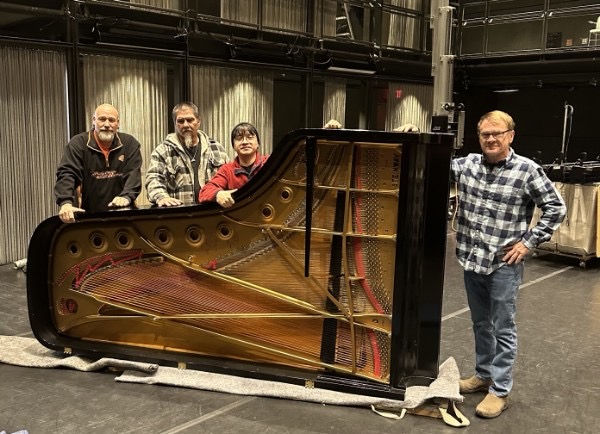
A spinet piano weighs about 300 pounds. A full upright is closer to 800. A concert grand can pass 1,300. All of that weight is distributed unevenly across a cast iron plate, held in a wooden case that was never designed to be carried, only to sit still and stay in tune.
That combination is why piano moving is a separate trade.
What happens to a grand piano
A grand does not go through a door on its legs. It gets partially disassembled. The lid comes off, the pedal lyre comes off, and the piano is lowered onto its bass side onto a padded piano board, a heavy skid built for exactly this. The legs come off while the instrument is supported on the board, not before. Then it's strapped, wrapped, and moved as a single unit on the skid.
Done properly, the piano never bears weight on a leg during transit. Done improperly, a leg snaps and takes a piece of the case with it. That repair costs more than the move did.
What happens to an upright
Uprights stay upright. They ride on a four-wheel piano dolly, wrapped in pads, strapped at the case. The danger with an upright is not the flat ground. It is stairs. An upright going down a staircase wants very badly to keep going. Controlling it takes ramps, straps, and people who have done it before.
The three mistakes we get called to fix
- Pushing on the keybed or the music desk. These are the two weakest structural points on the instrument and the two most convenient handholds. Push there and you crack trim, or worse, shift the action.
- Using furniture dollies. A standard four-wheel furniture dolly is not rated for a concentrated 800-pound load, and it has no way to secure the piano. It will roll out from under the instrument on any incline.
- Skipping the climate step. A piano that goes from an air-conditioned house into a hot truck and then straight into a cold house is going to move. Soundboards respond to humidity. Let the instrument acclimate in its new room before anyone tunes it.
Tune it, but not right away
Every piano goes out of tune when it's moved. That's normal and it isn't damage. Give the instrument two to four weeks in its new environment to settle at the room's humidity, then bring the tuner in. Tuning the day after a move means paying for the same work twice.
Where it sits matters
Interior wall, away from exterior doors, out of direct sun, away from a heating or AC vent. If you have a choice of rooms, choose the one with the most stable temperature. Your tuner will thank you for years.
Why we take this seriously
We move instruments for the Duke Department of Music, including concert grands that go onto stages and come back off. We've moved harps, organs, and a Mason & Hamlin that had been in the same family for three generations. The instrument that matters most to you is the one in your living room, and it gets the same crew and the same equipment.
See how we handle piano moves →
Moving in the Triangle?
Five generations of Durham movers. Free estimates, no obligation.
Get a Free Estimate Call 919-596-2469